After eleven years living, dancing, teaching tango, and writing in Buenos Aires, I came home to L.A. in 2014, where I'm reconstructing my life.
Showing posts with label Argentina. Show all posts

Sunday, February 12, 2012

The Laws of Tango BA Podcast

BA Cast's Fernando y Daniel are back with their fun podcasts, and this time it's the first of a three part bilingual documentary on the tango: The Laws of Tango: Dance.


 Soon to follow are Music, and then Lyrics & Philosophy.

Ruben and I, Cyrena and Lizzy, as well as Brit Tango Bob were interviewed in their studio, and they even went to Los Consagrados to talk to various "milonga characters."


I hope you will tune in to this informative and sometimes wacky podcast in Spanglish. And while you're on the site, sample some of their previous shows. You'll learn something and get a chuckle as well.


Tuesday, January 24, 2012

The Church of Tango: a Memoir, published January 21, 2012


Finally.

I started writing this story at the time it began--in February of 1992, when I was so depressed after my husband's death I wanted to swallow all of his left-over meds and follow him into the beyond. So what began in a way as a journal or diary became the chronicle of my road to survival in four countries. And once I made that decision to live no matter what tragedy came my way, I plugged on, through one tremendous loss after another, by dancing. No, not yet had the tango found me, but whatever dance there was at the time came to my rescue. I had always been a dancer, and now I knew dance could save me from despair.

As my adventures unfolded, the manuscript grew and grew. I had to make cuts in events, characters, reflections and realizations. That was the hardest part of bringing this story to fruition. There is so much left out. Who knows, maybe I'll write The Daughter of the Church of Tango, or a prequel one day.

Our students come from all over the world: China, The Philippines, Australia, Viet Nam, New Zealand, Hawaii, South Africa, India, Nepal, Finland, Russia, Israel, Scandinavia, all over Europe, Chile, Brazil, Colombia, Ecuador, Mexico, Canada and the U.S. And one question almost all ask me is, how did I end up teaching tango in Argentina?

This book is my answer.

Lots of women have come to Buenos Aires for tango, stayed a while, and went home and wrote about their experiences. There are a couple of tango histories available in English, as well as a couple of Buenos Aires milonga guide books. There are self-help books using tango as a way to better interpersonal relationships. There are some novels about tango in Buenos Aires.

My memoir is not like any of them; it is not a "tango book," but a story of survival that cuts across death, cancer, Alzheimer's, loss of home and homeland and cherished heirlooms and possessions, loss of shared histories, of hope for one's children, of hope for the future, of love. But it's also about finding love and unexpected joy. And about listening to the music and dancing.

It can be ordered from the printer online: https://www.createspace.com/3733773

Now available on Amazon and soon as an ebook for Kindle.

Sunday, June 05, 2011

Volcanic Eruption in Chile Affects Bariloche

El Nahuel Huapi May 29, 2011


Timing is always everything, isn't it? And fortunately the timing for us to visit the spectacular scenic area of Argentina's Patagonia, was perfect. Because one week later it is a disaster of volcanic ash, polluted water, closed airports, and empty supermarkets.


So we were lucky to enjoy the clean air and waters, but the people there now, especially those suffering as I do from asthma and bronchitis, are paying big time for living in God's country.

I never worried before about Acts of God or natural disasters such as earthquakes, being used to them in Los Angeles; severe shakes as I'd experienced in '71 and '94 never frightened me.

However, after a severe earthquake I still had clean air to breathe if not any china dishes or antique pottery. Air is the number one ingredient for survival, and in a quake, if a falling building doesn't get you, you are probably ok.

I was always philosophical about Acts of God because, as insurance forms are quick to point out, they can't be helped and are nobody's fault.

One thing about living in Buenos Aires is that there are no earthquakes, tornadoes, hurricanes, floods, or volcanic eruptions. No Acts of God in particular, just lots of acts of people, for better but often for worse.

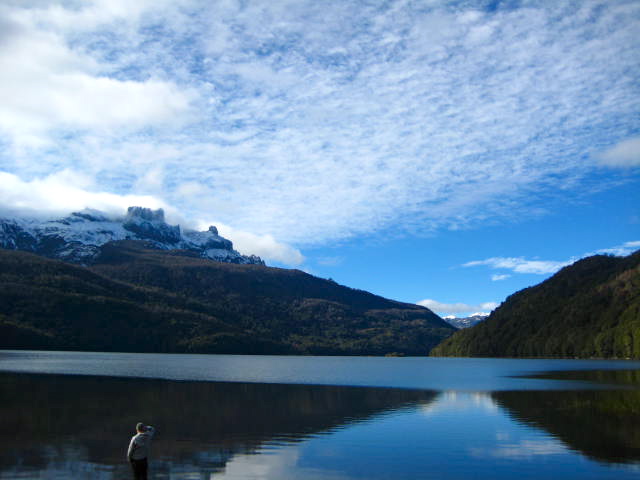
El Nahuel Huapi from a boat one week later
When I saw the videos on the news last night, of cars buried in ash in Bariloche, of day turned into night, of hospitals full of those who couldn't breathe--and with the week-old memory of the pristine skies and waters, I am heartbroken. My mind filled with images of Pompeii.

I believed that scientists could tell when a volcano was about to erupt, and people could be warned to leave the area. I guess not.

For nature, these events are not disasters, just things that happen in the scheme of the natural world. But for man--building his house on sand and damning the mudslides (as they do in Pacific Palisades, California), we need to have more respect. And appreciate when Mother Nature doesn't remind us who is the boss.

El Volcan Lanin, asleep for 3 centuries (it's covered in snow behind the green hill)

Thursday, June 02, 2011

Patagonia--Land O'Lakes 'n Chocolate

Plaza in San Carlos de Bariloche and Lago Nahuel Huapi

 Pristine waters, snow-capped mountains, fresh, clean air, piney forests--I had been dreaming about it for so long.


So when  DescuentoCity had a promotion for a week's trip for two to Patagonia and the Lake District, including air, at half price, we snapped it up.

Beef fondue just like in Switzerland

Our first stop was in San Carlos de Bariloche, the main town and the hub of most activities, including tango--we found a milonga downstairs in the Casino.
Espejo or Mirror Lake


 We passed along the Ruta de los Siete Lagos on the way to San Martin de los Andes, a posh ski center with wonderful restaurants and ski and chocolate shops. (No one leaves Patagonia without a box of chocolates!)
The most famous and pricey of chocolates is Mamushka


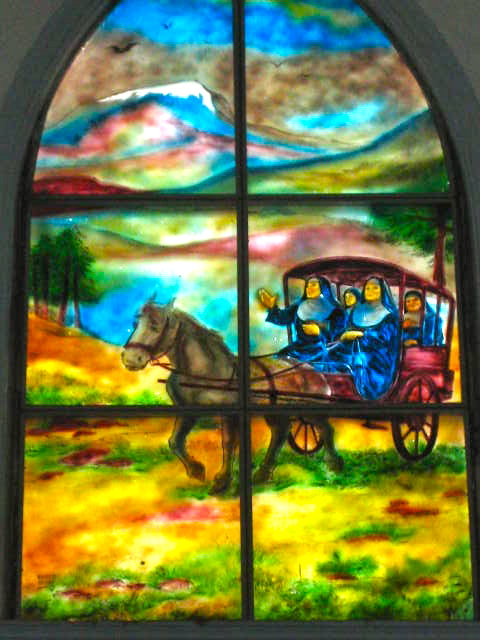
Santuario Nuestra Senora de las Nieves, Our Lady of the Snows, in Junin de los Andes

The windows all had scenes of local life

Lago Escondido


 Being low season and between foliage a month ago and snow next month, it felt like we had all Patagonia to ourselves!

I had heard so much about Bariloche and its Alpine architecture and chocolates that I expected it to be kitschy and Disneyesque. Instead, the chalets are charming and the region indeed reminded me of the Swiss and French Alps, where I have spent a lot of time in the past. The landscape and flora are reminiscent also of Lake Tahoe and Taos, New Mexico, and, in places, even Palm Springs.


Villa La Angostura was our final stop for two nights at the luxuriously peaceful country inn on the lake shore, La Posada. The quiet little town doesn't have much of anything to do, and so finally we just relaxed.

Shopping arcade in Villa La Angostura

view from our room
We toured National Parks, ate lunch at a Mapuche lodge in the woods, and snapped away because every moment was a photo opp. We also picked up the occasional piece of trash to carry back to town, as the whole area is super environmentally conscious. If you fish (with a license, of course) you can only keep one fish per day. But the restaurants are full of trout and Patagonian lamb. The good food and the pure air made me feel wonderful.
Ferry 

I can't wait to go back!


Wednesday, February 23, 2011

Carnaval en Gualeguaychu

Note: for MUCH better photos, please check out NW Nomad.


Gualeguaychu, in Entre Rios, is sort of a back-water, one-horse pretty little town on the shore of the Gualeguaychu River, about three hours by car from Buenos Aires and close to Uruguay. No high rises, no gourmet restaurants, very few buses, lots of bicycles, people sit out on their curbs at night during the summer to cool off. But what it does have, since 1997, is a Carnaval to rival that of anywhere in the world!

During the military dictatorship, Carnaval and Murgas, as well as tango, were suppressed. But all three have come back with a vengeance! Well ok, Gualeguaychu doesn't have tango, but Guau! What a carnaval--every Saturday night in February and through the middle of March.

Five years ago, we made a turn-around trip in one day with a tour company, Eternautas. It was hot and cramped in the small van, we were all exhausted from the Corsodromo parade which didn't end until after 3:00 a.m., but worst of all, that was the night of Ruben's first gall bladder attack--and it was bad.

Typical Gauchito Gil altar along the road
So we wanted to revisit the Comparsas under more pleasant circumstances. We drove up in Ruben's old batata, passing many Gauchito Gil altars on the three hours through the pampas.

We stayed in a lovely posada for four nights. Ruben went fishing and to the Casino, I read and relaxed, and we swam in the dark pool at night to cool off. Saturday night we walked over to the Corsodromo (which used to be the train station) and had cocktails on the grass while we watched the people buying feather headdresses and posing for photos.

Every weekend there are three comparsas competing in the Corsodromo, each one with their floats, amazing costumes which are mostly feathers and glitter, dancing boys and girls, snazzy orchestra and singers, and batucada band. We saw Kamarr, Mari-Mari, and Ara Yevi.


She was the leader of the Nazis.
My favorite was Mari-Mari, just as five years ago. Their 2011 theme is Pesadillas, or Nightmares. Think Cirque du Soleil. Beginning with a boy reading scary stories in bed, with every kind of feather-bedecked nightmare dancing after him in the parade: spiders, bats, dragons, vampires, monsters, werewolves, German Secret Police, royals followed by a guillotine, and all bouncing along the way to the infectious Mari-Mari music like colorful chickens. A gigantic float was a writhing haunted house with claws moving beds in and out--with a person screaming on each bed! Most of the floats are hand pushed or pulled but a very few are pushed by tractors.

I'm so sorry my photos can't do the Pesadillas de Plumas justice. And oh yes, there were gorgeous barely dressed young beauties as well.


 I can't praise the concepts high enough, with the clever, intelligent, inventive, witty flow of fun. Just when you think you can't be awed or surprised anymore, here comes a comic character, a rollicking grim reaper, or a dancing Dracula.


The final Comparsa ended their parade of "Education," (at least that's what I think the theme was) with the best batucada group of the night--and they were all wearing motarboard caps and gowns! But you have to see the video. Ruben took video, but it's very hard if you're not in the first row. We were in the fourth row and even so had to stand up on chairs and it still seems like we got nothing but the big heads of the folks in front of us.


DETAILS: 
We stayed at La Posada del Puerto with a view of the river and a giant swimming pool, a treat at any season. They also have a gym and spa.


 We ate at Campo Alto twice, and enjoyed great meals and live folk music.

However the other 2 restaurants we tried (La Cascada and El Argentino) were awful.


More info on Carnaval en Gualeguaychu. And here in WelcomeArgentina.

Saturday, January 22, 2011

Is Buenos Aires Still Cheap? Was It Ever? Tango Tourist Tips

My first trip to Buenos Aires in 1997 was very expensive--the dollar was pegged to the peso and the city was as expensive as Paris. However I remember well that a bottle of Lopez vino tinto was 2 pesos, or $2 usd.

When Argentina defaulted on its foreign loans in 2001, the ensuing economic crisis caused the peso to fall to 3 to 1, and folks to lose their jobs and homes. Mortgages were payable in dollars which caused the payments to quadruple. Banks closed to prevent people from withdrawing all their money before its value fell even more. Going though several presidents in only a few weeks, Argentina dropped from being the most expensive city in Latin America to the cheapest in just one year.

So at the beginning of the new century, peso prices were low if you had dollars to spend, and many tourists flocked here to do just that, including buying real estate.

The reputation of living cheap below the Equator in a "third world latin country" has lasted way longer than its validity. Nowadays those who can afford to and who have U.S. visas fly to Miami to shop.

Nowadays Buenos Aires is a very expensive place to live. The only thing that is more reasonable here than my home town of Los Angeles is housing, but due to California's recent economic problems, even that is changing. But oh yes, tango shoes are still a steal!

It's worse for the locals, of course, but they are used to the unbelievable 30% inflation and doing without. It can come as a shock, though, to tourists traveling on the cheap to find that basic expenses can be the same as "back home." And luxury items and anything electronic are incredibly expensive.

One can manage by lowering one's life style and expectations, but the older we are the harder it is to do that.

Remember that there is no Target, Trader Joe's, or .99 Stores here--everything is full price and usually then some--if you can find it.

My advice to the Tango Tourist, especially the First Timer:

1) Don't bring lots of clothes. No ones knows or cares if your outfit is designer from Barneys of New York. And in fact, it helps for you to look the same at the milongas so that folks recognize and remember you. That said, ladies, plan on not wearing wigs or changing your hair style too drastically. If you have a dress or blouse with back interest, that shows off better than the front while dancing.

2) Bring just one pair of comfortable tango shoes if you have them. You will want to pick up more while here, but in any event, it is not necessary to have zillions of different shoes color coordinated to go with every outfit; this marks you as "tourist." Two or three basic black in leather and/or suede will do for the men--goat skin, or cabra, is the most flexible and comfortable. And please don't fall for the two-toned. Ladies only need a pair or two in black, one in red, and another in a color. Beware of glittery or white shoes unless you have perfect footwork.

3) Bring a very comfortable pair of walking shoes, preferably not white.

4) If you're not that fond of bland food, bring a small bottle of Tabasco Sauce and as well as some Lemon Pepper, garlic salt, or whatever else that gives flavor and makes you happy.

5) If you love cocktails more than wine, pick up a bottle of your favorite spirits in the Duty Free.

6) Leave your good and/or flashy jewelry at home. Cheap costume stuff is the way to go here.

7) Bring your iPod and your laptop. Most tourist residences have wifi, and many cafes do too. Then you can download your photos and add tango and folklore music to your iPod on the spot. CDs of local music are much cheaper than at home, and furthermore most tango DJs sell great music for dancing to those who inquire at the milongas (don't worry; they pay their union/copyright fees)

8) Bring your favorite perfume, cosmetics, and OTC drugs; while many are available here (and many not), the prices are extreme. If you think you may get an infection, know which antibiotic works for you and your condition, as you can buy them OTC here. The controlled drugs are the addictive ones, like Ativan, and you do need a prescription for those.

9) Forget about ethnic food; get used to the delicious cuts of beef and pork that abound. And if your habit is to go out for breakfast, get used to coffee and sweet rolls with fake orange juice. Better and healthier to eat breakfast at your hotel or apartment and have cereals and fruit.

10) Don't walk the streets and wait for buses in fancy dancing attire; even if it's hot, cover the décolletage with a scarf until you get to the milonga.

11) Never take drinks into a milonga and put them on your table. You must order a consumacion from the waiter as well as leave him or her a tip.


12) Your best bet is to bring clean, new dollars to exchange for pesos. Forget travelers cheques; nobody takes 'em and nobody wants 'em. Don't rely on paying for everything with a credit card. But bring 2-3 ATM cards, the easiest way to get local cash.

13) Don't worry about going to fancy and expensive restaurants. Chances are the food is better at home. Just stick to Argentine beef, wine and salads.

14) One tango show is like another; if you must go, choose the cheapest.

15) Have a good guidebook, like SallyCat's Happy Tangos.

The old glory days in Argentina are long gone. How I would have loved to be here in the 40s when you could choose which fabulous orchestra to dance to every night; when folks dressed to the nines and men had to have polished shoes and a coat and tie to enter a milonga, when life--and the language--was more polite and formal.

The old adage still is true: bring less stuff and more money. Other than leather goods, there's not really a lot of appealing things to buy and take home. Your money is better spent on good private tango lessons, lots of milongas, and taxis for late at night when you are tired, and even a taxi dancer if you want to quick-start your milonga experience. Splurge on the memories, which can be priceless.

Saturday, October 23, 2010

La Vida Gauchesca

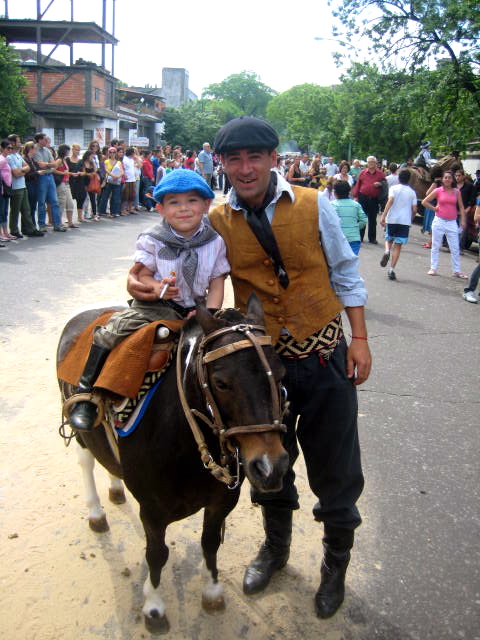
At the top of my list of things I love about Argentina is the gaucho life and history, and especially as it relates to tango. I love the mystique and above all, the outfits. Gauchos today correspond to the American cowboy, in that they still live the life with their horses, which in the provinces of Buenos Aires, they keep at home.

You can see genuine gauchos in Buenos Aires every winter with their animals at the Fair and Exposition in La Rural, and every Sunday from April to December at the Feria de Mataderos. 

At Mataderos you can see them ride in a competition of the sortija, the winner earning a purse. And you can learn more about gaucho history in the Museo Criollo. (Read more Mataderos posts on tangocherie.)

Gauchos also have their own confederation, which you can check out in Spanish on the web.


The gaucho figures strongly in the history and life of Argentina. Centuries ago when there was wild cattle roaming the country, the gaucho made his living by herding and selling them, banding together with his comrades to get a job done, and then going off after his solitary life again. Each man was allowed to round up 12,000 heads. When a cow was killed, the gaucho threw the tongue on the fire and ate that, so as to not ruin the carcass he needed to sell. He lived on beef and mate, and had the company of a "china" (country girl) and his guitar.

When the pampas began to be fenced in and owned by grand estancias in the 19th century, the gauchos had to look for another type of work. Some took jobs at the estancias, and many came to Buenos Aires and had to wear closed toed shoes for the first time in their lives, as the gaucho boots left their toes free. See illustrations of their clothing here.

Aside from his horse, the gaucho prides himself on his skill with the  asado, or barbecue, which truly is an art. He doesn't use charcoal, but wood, and keeps moderating the temperature of the fire by adding and subtracting the coals. He adds coarse salt during the slow cooking to keep the meat from drying out right before he turns it over, bones down. All parts of the animal are eaten, including the fat.

In Argentina, it's only the men who are asadores.

Here is a famous verso gauchesco:

El Gaucho
Mi gloria es vivir tan libre como el pajaro del cielo, no hago nido en este suelo ande hay tanto que sufrir; y naides me ha de seguir cuando yo remonte el vuelo.

Tuesday, February 02, 2010

Gaucho Gourmet


Francis Mallmann is Argentina's star chef. I accidentally caught his TV show as he was cooking amazing hot salads in the middle of a field of snow. Alone. With his famous accoutrements of an upholstered love seat, DVD player, artistic fire rings, and his sports vehicle which hauls everything around (along with his cameraman, I assume.)

First of all, he has great charisma, a part of being a "star" anything. But it was so dramatic, romantic, and sexy to see him prepare the gourmet food--that wasn't a side of beef-- in the middle of nowhere. He kept me glued to the screen. You can read more about his gaucho grilling here.

But what you really want to do is catch his show on the Gourmet channel (elgourmet.com), and be inspired. It was a bit of a shock to me, but there is more than meat to eat in Argentina!


Sunday, October 04, 2009

Gracias, Mercedes


Mercedes Sosa 1935-2009


More info

La Negra is singing with the angels now.
Gracias, Mercedes, for your life, art, music, presence on this earth.

Thursday, September 24, 2009

Enduring Antarctica


Argentina is far, far from home for most expats who live here and the tango tourists who visit. Some of us are able to travel a bit and experience more of Argentina than Buenos Aires. And some folks come this far south because they have a passion for Antarctica. (The closest I will probably ever get is rounding Cape Horn on a cruise ship, as I did last April.)


Londoner Jenny Diski writes about her trip to the end of the world in her excellent memoir, Skating to Antarctica, and also about the ill-fated and brave expedition of British Ernest Shackleton and his ship, the Endurance, on the Imperial Trans-Antarctic Expedition in 1914.


During Diski's cruise, the documentary film of Shackleman's historic voyage was shown to the passengers, and Diski's writing about it sounded so fascinating I looked it up on YouTube. It's there, in 11 parts, and well worth the effort of viewing. Amazing dramatic footage of brave and strong men and their dogs, and of the ship breaking up in the pack ice. Especially memorable was watching the men hauling the ship by ropes through the ice.
Watch Endurance, Shackleton, and the Antarctic.


If we are interested in Argentina, we owe it to ourselves and to the country to know something of its history, including the Falklands, the islands of South Georgia, Elephant Island, and Antarctica. Not all of us have a burning desire to see the South Pole, but while we are relatively "close," it's something to think about. And read about, and above all, to know about.

Wednesday, September 09, 2009

Tango Rosarino


Ever since I started to dance tango way back when in Los Angeles, I had heard about tango in Rosario--mostly I suppose because at that time Rosario's Orlando Paiva was the tango teacher in L.A.

So long overdue, Ruben and I decided to check out tango Rosario, and soon we were sitting on a comfortable bus for the short (4 hours) trip.

We left on a Sunday so as not to miss our favorite Buenos Aires milonga, Los Consagrados. And because we were invited to attend the Sunday night milonga, Las Chirusas, which is at the Cafe Flor, Mendoza 862.

A charming old house, Cafe Flor has an indoor area with a stage and an "outdoor" dance floor for smokers. Both floors are old decorative tile. The crowd was mostly young, and almost all the women held their left arms low and lower on the man's back. Because of our discussion on this after the Campeonato post (see comments), I was paying strict attention. I wish I could have taken photos, but restrained myself. (I feel another post on this topic coming on.)

What I enjoyed most about Las Chirusas was the music. Nothing special about the selections, all old-guard, but the sound was just perfect in the small room, and I heard new things in the old songs.


In between milongas, we took a long walk by the river, where Ruben looked for places to fish. Unfortunately it was cold, wet, and windy, so we gawked at Rosario's famous monument to the flag (huge and macho and built in the style of what I call Fascist architecture).


Monday night we taxied to La Buena Medida (Buenos Aires y La Rioja) for tango and malbec with our new friend from Las Chirusas, Hugo. The organizer, Hernan, was friendly and the ambiance in the old historical cafe was relaxed and fun. The floor was also old decorative tile, and a bit heavy in all the humidity. I wished I had worn my smooth leather soled CIF's from the night before.

BTW, the "milongas" of Rosario are very informal, and the cabeceo almost unknown.


And so we had our two nights of Tango Rosario. Next time I want to plan to be there on a Tuesday, when Las Chirusas has a big milonga at the Ex-cine Carlos Gardel (Ov. Lagos 790), which has a wood floor, is large and I hear, gorgeous.


View from our lovely room at the Urquiza Apart Hotel.

Friday, July 24, 2009

"Romantic Argentina"

Here is a delightful MGM travel short on Buenos Aires in 1932.
Shown are some wonderful details that have disappeared forever, as well as some things so much the same.
Enjoy!


I tried to embed the video, but it won't let me; please click on the link:

Monday, July 13, 2009

Swine Flu or The Buenos Aires Crud?


Many readers of tangocherie have written me lately wondering about the dangers of flu here in Buenos Aires, and if they should cancel their planned trips. Up to now, I've sort of ignored this theme in my blog, knowing it will soon pass and that the media has blown it all out of proportion across the globe. But the panic outsiders feel is real.

This article,
Argentines told to stop kissing to curb spread of H1N1 flu, published last Saturday in the Borneo News, is a perfect example of bad journalism. It promotes the swine flu panic and is downright incorrect in stating that the "tango halls" are closed.

Here's the advice I write to inquirers:
From my point of view, except for theaters and the
schools,life here is normal. The milongas are
perfectly normal. I could throttle whoever it
is who's spreading gossip about "closed milongas,"
rabble rousers all. During winter here there are
always fewer tourists and folks who stay at
home with colds and flu of whatever variety,
however we've been extremely busy with lots
and lots of dancers from Australia.

No one is wearing masks in the street,
restaurants aren't closed, etc.
So just do what you're comfortable with.
There are never guarantees that
something will not
go wrong on vacation.

The truth is that I haven't blogged about the flu scare because it hasn't affected us. I don't know anyone who's had it. The milongas aren't closed, there are just as many people dancing in them and in the streets and restaurants, and I honestly forget about it until I listen to the news. But the basic theme is beginning to bore everyone and life--and the headlines--is moving on.

Many folks however do get sick with what I call the BsAs Crud when they arrive here due to allergies, pollution, exhaustian, whatever. That's a fact.

No one can promise a totally healthy vacation, but there are more tourists here than ever, and all appear to be having a great time.

So the scare is leveling off and Buenos Aires is tranquilo--until the next panic. Such is life.

So come on down! We'll be here waiting for you!


Thursday, May 28, 2009

Ushuaia Prison Museum; Carlos Gardel -- a Convict?


Will tangocherie ever stop blabbing about her cruise around Cape Horn?


Eventually. But for now that glorious trip still sticks in her mind as one heck of a fabulous AH HA! for two weeks of experiencing, enjoying, teaching tango, and learning about Argentina and Chile.

And in the best of all ports, Ushuaia, I learned in the Prison Museum that our Tango God, Carlos Gardel, purportedly served time! I tried to find out for what, but it seems that it's just another Gardel myth, like his birth place and real name, among others.

As with all icons, don't try too hard to find the truth. And so the powers that be of the Museum have made the most of the myth by decorating his supposed cell with a mural and stories about the "Charles Gardés" incarcerated there in the early teens of the 20th Century (see bottom photo).

No matter who the actual prisoners were, it's a fact that they constructed the prison from 1902 to 1920. They also built the railroad, the southernmost railway in the world, and just about everything else in the little port town of Ushuaia at the End of the World. The prisoners did everything important in the town, from logging, telephones, newspaper, electricity, and the fire station. The jail also had several ships, which makes sense when you think about how prisoners got there and how isolated is the port.


The building's circular area in the first photo above was the convicts' latrine. The sign is sure prettier than the reality.


More info here (in Spanish.)

Read here the Letter refuting Gardel's imprisonment by Juan Carlos Esteban.