After eleven years living, dancing, teaching tango, and writing in Buenos Aires, I came home to L.A. in 2014, where I'm reconstructing my life.
Showing posts with label Mataderos. Show all posts

Monday, June 11, 2012

Gaucho Fair in Mataderos

Every fair has its virgin.

Over the years I've often written about my favorite thing to do in Buenos Aires--after the tango: visit the Feria de Mataderos. 

One of the services we provide our students is an excursion to the Fair. But yesterday Ruben and I just decided to go there alone for lunch at our favorite parrilla. A beautiful day, the fair was bustling with more visitors, more booths of arts and crafts and regional foods, more music and dancing than ever.

If you'd like to visit, check out the Fair's website for all the particulars. Just remember it's closed during the summer, and don't go if it's raining. And of course you can also take a tour there with us as your guides. Ruben is a fount of information on the gaucho history and tradition and how it relates to the tango. Just email for information: tangocherie at gmail dot com.

Meanwhile, here are some snaps of yesterday's trip. Because in previous blogs about Mataderos I concentrated more on the gauchos and their horses and the music and the dancing, this time it's about shopping for food and gifts.


A coffee wagon

Who wouldn't buy country cheese from this guy? We did.

You can outfit your self completely from head to toe as a gaucho or his girlfriend, "china."

Old books for sale--did gauchos have much time for reading?

Horsey stuff one might need along with a leather mate kit

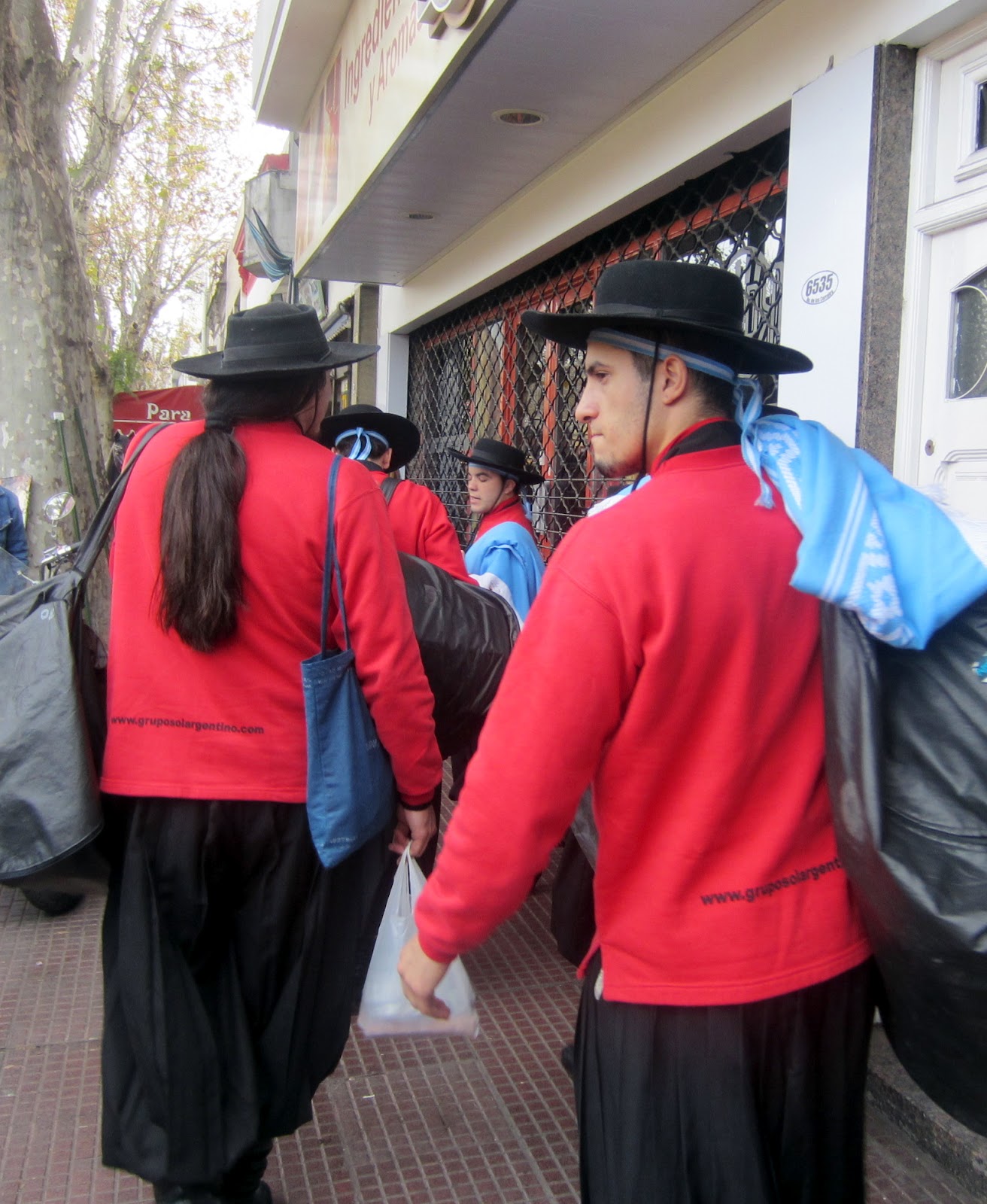
Troupe of folkdancers

Never come because a gaucho and his china!
The artist standing behind his wares will happily make you a custom plaque in the distinctive porteño style of afileado.

Lots of country cheeses from all over Argentina


Like leather? Here's the place to get inexpensive hand made craft work

Leaving the fair after a fun afternoon


Saturday, April 02, 2011

Gaucho Fair at Mataderos Opens Again!


The Mataderos Fair is open again! Hooray! My favorite way to spend a Sunday in Buenos Aires! Check out the website for information on all of the activities, performances, shopping, and eating.

(A repost from 2010)


Tango tourists often engage us to take them to various points of interest, such as La Boca and Caminito, San Telmo, and the Feria de Mataderos being the most popular destinations for our Tango Tours. Ruben is a fountain of information on the history, background, culture of the tango and old Buenos Aires.

A friend just asked me if it wasn't boring to return over and over again to places where I've been so many times.

The answer is absolutely not because each time it is a different experience. But even more so at the Feria de Mataderos.

Newly reopened today for the season (until the middle of December), it's the best way to spend a fine Sunday in Buenos Aires. (closed when it rains)

Tomorrow the weather looks like it will be perfect. Why not take advantage and Hie thee to the faire?! You won't be sorry. Try to get there early (noon) and have an asado lunch in time to see the Gaucho Games which begin around 3:00 p.m. Please don't overlook the Museo, which aside from the interesting displays, gives you a peak at a historical building unchanged for more than a century. (They also have a nice bathroom, FYI.)

If you'd like us to take you some Sunday, just make a reservation in advance.

Monday, November 29, 2010

Twenty-four Long and Exciting Hours


A couple of weeks ago we left the Milonga de los Consagrados to go out to a club in Banfield to perform a vals, tango, and milonga at a private fiesta. Ruben was wearing his beige suit for the occasion. Then we drove back in the opposite direction to milonga Los Bohemios in La Boca where Ruben was to act as a judge in a tango contest.


The tango club has indoor parking because La Boca is not the best place to be late at night wandering the streets. However when we left at 4:00 a.m., we had a flat tire. Ruben wanted to change it at a service station where there was more light and security, so we drove on the rim to one a few blocks away. He changed it, not doing the beige suit any good, and we made it home, just a couple of hours before we were to take a tourist group to the Feria de Mataderos, where we all had a great day. And we got back in time to teach a class at 8:00 p.m.


Whew.

P.S. Last week Ruben's car was stolen at twelve noon while we were at the supermarket buying fixins for Thanksgiving. I hope the thief got a flat; Ruben thinks he probably ran out of gas!

Saturday, October 23, 2010

La Vida Gauchesca

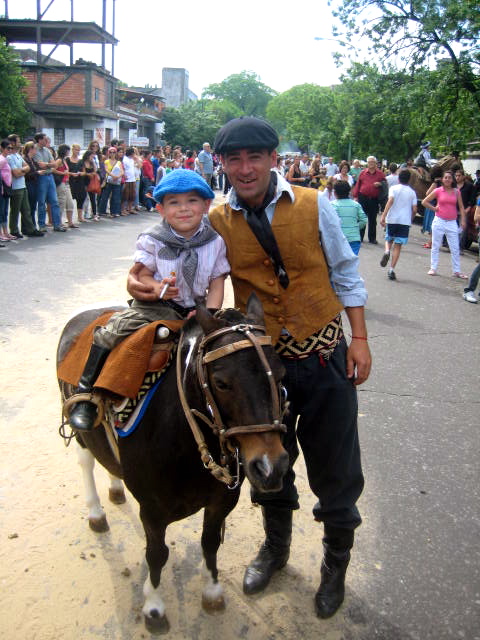
At the top of my list of things I love about Argentina is the gaucho life and history, and especially as it relates to tango. I love the mystique and above all, the outfits. Gauchos today correspond to the American cowboy, in that they still live the life with their horses, which in the provinces of Buenos Aires, they keep at home.

You can see genuine gauchos in Buenos Aires every winter with their animals at the Fair and Exposition in La Rural, and every Sunday from April to December at the Feria de Mataderos. 

At Mataderos you can see them ride in a competition of the sortija, the winner earning a purse. And you can learn more about gaucho history in the Museo Criollo. (Read more Mataderos posts on tangocherie.)

Gauchos also have their own confederation, which you can check out in Spanish on the web.


The gaucho figures strongly in the history and life of Argentina. Centuries ago when there was wild cattle roaming the country, the gaucho made his living by herding and selling them, banding together with his comrades to get a job done, and then going off after his solitary life again. Each man was allowed to round up 12,000 heads. When a cow was killed, the gaucho threw the tongue on the fire and ate that, so as to not ruin the carcass he needed to sell. He lived on beef and mate, and had the company of a "china" (country girl) and his guitar.

When the pampas began to be fenced in and owned by grand estancias in the 19th century, the gauchos had to look for another type of work. Some took jobs at the estancias, and many came to Buenos Aires and had to wear closed toed shoes for the first time in their lives, as the gaucho boots left their toes free. See illustrations of their clothing here.

Aside from his horse, the gaucho prides himself on his skill with the  asado, or barbecue, which truly is an art. He doesn't use charcoal, but wood, and keeps moderating the temperature of the fire by adding and subtracting the coals. He adds coarse salt during the slow cooking to keep the meat from drying out right before he turns it over, bones down. All parts of the animal are eaten, including the fat.

In Argentina, it's only the men who are asadores.

Here is a famous verso gauchesco:

El Gaucho
Mi gloria es vivir tan libre como el pajaro del cielo, no hago nido en este suelo ande hay tanto que sufrir; y naides me ha de seguir cuando yo remonte el vuelo.

Saturday, May 01, 2010

Each Time New: The Gaucho Fair is Back in Season!


Tango tourists often engage us to take them to various points of interest, such as La Boca & Caminito, San Telmo, and the Feria de Mataderos being the most popular destinations for our Tango Tours. Ruben is a fountain of information on the history, background, culture of the tango and old Buenos Aires.

A friend just asked me if it wasn't boring to return over and over again to places where I've been so many times.

The answer is absolutely not because each time it is a different experience. But even more so at the Feria de Mataderos.

Newly reopened for the season (until the middle of December), it's the best way to spend a fine Sunday in Buenos Aires. (closed when it rains)

Tomorrow the weather looks like it will be perfect. Why not take advantage and Hie thee to the faire?! You won't be sorry. Try to get there early (noon) and have an asado lunch in time to see the Gaucho Games which begin around 3:00 p.m. Please don't overlook the Museo, which aside from the interesting displays, gives you a peak at a historical building unchanged for more than a century. (They also have a nice bathroom, FYI.)

If you'd like us to take you some Sunday, just make a reservation in advance.

Saturday, October 10, 2009

Authentic Souvenir Shopping in Buenos Aires

Here's tangocherie's first guest post, this from Best Travel Deals.
Read on to the end for a couple of suggestions of my own.

One of the stresses of travel is souvenir shopping. The fastest way to lose friends and alienate people is to cut them out of the perfunctory gift giving that has become a mandatory post-travel practice. So when you wake up on your last day of vacation, in a cold sweat, remembering you forgot to pick up something for your sister’s kids you don’t have to settle for the cheesy key chain emblazoned with their name at the airport gift shop. In fact, here are some alternative ideas so that you never have to set foot in another soul crushing souvenir shop ever again.


Souvenir shops like the one pictured above are for the unimaginative and lazy. Just because something is found in a souvenir shop does not always mean that it is truly representative of the country you’re in. For instance, thongs emblazoned with the country’s name in gold are generally a no-no. For something that’s going to be truly reminiscent of your host country, in this case Argentina, go where the locals go.

Flea Markets

For something unusual and quirky take a trip to Palermo’s Mercado de Las Pulgas (Niceto Vega block 200 between Dorrego and Concepcion Arenales) where many antique shop proprietors head to in search of inventory. From reclaimed furniture to taxidermy there’s something for everyone here and best of all, haggling is a must.


Argentines are a creative group of people and having largely descended from Italian immigrants, aesthetic means a lot to them. Everywhere you look design has been integrated into daily life and two home-good shops that whole-heartedly embody this ethos are Calma Chicha (Honduras 4909, Palermo SoHo) and NoBrand (Gorriti 5876). There are three hallmarks of Argentine culture: leather, mate gourds, and penguin shaped jugs, all of which have been updated from their traditional, pueblo form into modern and stylistic pieces. On any given day you can find these shops swarmed with young, fashionable Argentines looking to capture their culture in the most updated forms.


Antique Markets

The San Telmo antique market (Plaza Dorrego, every Sunday) is one of the most popular weekend activities in the city. Located in the oldest part of the city, San Telmo is characterized by its abundance of antique shops running the gamut from low to high-end. It’s the only neighborhood in the city that is completely devoted to selling its past, so it makes for perfect souvenir hunting grounds. The market sets up in the main square around 10 in the morning and snakes its way through the neighborhood north and south through cobble-stoned streets. Get there early to battle the crowds because by 1 the streets have usually been turned into a sea of bodies.


The Grocery Stores

If you ever spend a single day in Argentina you will inevitably eat dulce de leche at some point. Dulce de leche is to Argentines what peanut butter is to Americans and Nutella is to Europeans. Similar to caramel it’s an addictive treat that the Argentines put on almost everything; toast, yogurt, ice cream and donuts for example. The best thing about dulce de leche is that a 1-kilo tin of it (2.2 pounds) will cost you about $4.00 US and will last you long enough to get back home.


Tangocherie adds:

The very best gifts from Argentina are tango shoes and leather jackets, but if you're looking for something smaller and/or cheaper, you can not go wrong at the Feria de Mataderos (Sundays). The choices are many and the craftmanship high, prices are reasonable and the selection varied. The Feria is a fabulous place to buy something "horsey," either used for riding or things with horse motifs, but there are hand tooled mates, clothing, toys, jewelry, etc. Also there are food booths featuring delicacies from all around Argentina. There are also lots of gauchos, horses, music, and folklore. You can read past posts on my blog here. Just remember that Mataderos is closed from the middle of December to the middle of April.

If you have any friends back home who are Boca Junior fans, there is a museum next to the stadium in La Boca which sells "official" souvenirs sure to please (not cheap though.)

Happy shopping!

Monday, July 06, 2009

Magical Moments in Mataderos


Sometimes we experience moments of grace, probably when we least expect them. But they always seem to happen to me at the Feria de Mataderos.

Today we were there with a tango student from Albuquerque. The weather forecast was good, and we had checked several times that the fair was open despite the flu scare.

We arrived early as usual, before the live performances began on the stage. People, ordinary folks, were folk dancing in the street to recorded music. I noticed a middle-aged woman beautifully dancing La Zamba by herself. (Zamba is the national dance of Argentina, and is even more sensuous than the tango.)


Then, while Ruben went to the ArgenChino supermarket to buy our wine for lunch, this lady taught the escondido to a young girl. After a couple of chacareras, another zamba came on. The lady began to dance alone again, and a tall thin, handsome gray-goateed man, bounded out of the crowd and became her partner. (Why didn't I have my Flip video camera with me?) It was so gorgeous and elegant, and like the tango should be danced, so natural. When the dance finished, he disappeared back into the crowd and was gone. That dance was awe-inspiring. Even more so if I fantasized that the man and woman did not know each other.


Off then to our usual parrilla, only to see armadillos on the grill! Our student Raymond was all for trying it, but the asador was just grilling them for a friend and so they weren't for sale.


Look at the dove in the niche of the tree!


Next stop, the Criollo Museum, where we saw a typical gaucho's rancho, a pulperia, and then, in the courtyard where heavy rain suddenly began to fall, a real gaucho brushing his real horse, Rodrigo. The gaucho gave me a sugar lump to make friends with Rodrigo, and I fell in love.


Outside the museum, it was hailing golf balls as musicians rushed under the arcades with their guitars and mandolins, and played and sang folklore; the crowd, waiting for finer weather, joined in, Ruben belting out the familiar sad songs with gusto. It was a very special moment.


We also ran into fellow-bloggers Sallycat (with her Carlos) and Debbi, thanks to the miracle of text messages.
Que dia hermoso!