After eleven years living, dancing, teaching tango, and writing in Buenos Aires, I came home to L.A. in 2014, where I'm reconstructing my life.

Monday, October 25, 2010

Besitos Locos!


Ruben and Coquito have a thing going. But I'm not jealous--I love them both!

Saturday, October 23, 2010

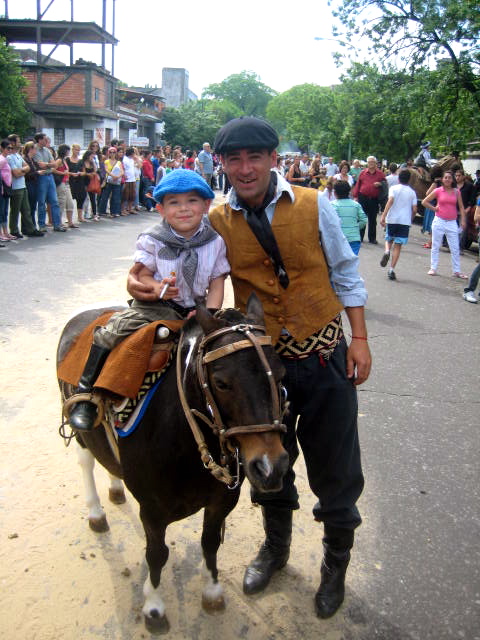
La Vida Gauchesca

At the top of my list of things I love about Argentina is the gaucho life and history, and especially as it relates to tango. I love the mystique and above all, the outfits. Gauchos today correspond to the American cowboy, in that they still live the life with their horses, which in the provinces of Buenos Aires, they keep at home.

You can see genuine gauchos in Buenos Aires every winter with their animals at the Fair and Exposition in La Rural, and every Sunday from April to December at the Feria de Mataderos. 

At Mataderos you can see them ride in a competition of the sortija, the winner earning a purse. And you can learn more about gaucho history in the Museo Criollo. (Read more Mataderos posts on tangocherie.)

Gauchos also have their own confederation, which you can check out in Spanish on the web.


The gaucho figures strongly in the history and life of Argentina. Centuries ago when there was wild cattle roaming the country, the gaucho made his living by herding and selling them, banding together with his comrades to get a job done, and then going off after his solitary life again. Each man was allowed to round up 12,000 heads. When a cow was killed, the gaucho threw the tongue on the fire and ate that, so as to not ruin the carcass he needed to sell. He lived on beef and mate, and had the company of a "china" (country girl) and his guitar.

When the pampas began to be fenced in and owned by grand estancias in the 19th century, the gauchos had to look for another type of work. Some took jobs at the estancias, and many came to Buenos Aires and had to wear closed toed shoes for the first time in their lives, as the gaucho boots left their toes free. See illustrations of their clothing here.

Aside from his horse, the gaucho prides himself on his skill with the  asado, or barbecue, which truly is an art. He doesn't use charcoal, but wood, and keeps moderating the temperature of the fire by adding and subtracting the coals. He adds coarse salt during the slow cooking to keep the meat from drying out right before he turns it over, bones down. All parts of the animal are eaten, including the fat.

In Argentina, it's only the men who are asadores.

Here is a famous verso gauchesco:

El Gaucho
Mi gloria es vivir tan libre como el pajaro del cielo, no hago nido en este suelo ande hay tanto que sufrir; y naides me ha de seguir cuando yo remonte el vuelo.

Tuesday, October 19, 2010

Those Mysterious Milonga Codes

Most tango dancers around the world have heard of the "codigos" (unwritten rules of the milongas in Buenos Aires) and know a little bit about the cabeceo, or the head-nod invitation to dance. Also, at many international tango festivals there is discussion about the line of dance, la ronda, and how leaders need to manage it, which is also covered by the codigos. These two aspects are the most well known of the milonga codes.

But do you know that there are more than forty codigos of how to behave, from when you enter the milonga until you leave? There is etiquette to cover every situation (before it becomes a "situation").

Many foreign tangueros don't know or care about "old-fashioned" rules from a time and culture gone by. But the Argentines have been dancing tango in Buenos Aires for 150 years and have figured out a few things about how to conduct themselves at a milonga. The tried and true codigos are for everyone's benefit.

Tourist dancers in Buenos Aires sometimes rebel and want to act as they are used to at milongas in their countries. But out of respect for tradition, the local tangueros, and the tango itself, it behooves one to learn and follow at least the most important of the codigos while dancing in the traditional milongas of Buenos Aires.

I'm not going to list them here, because you can find the "rules" elsewhere on the web. Suffice it to say they are all about common courtesy. Here are some sites that discuss the codigos: La Milonga (español), Tango Chose Me,
 Tips for Cabeceo Success, Crossroads, and once more a great article from Tango and Chaos--All the Meat on the Fire.

Friday, October 15, 2010

Medical Concerns of The Expat Life

Do you dream of being an expat somewhere? Do you imagine retiring to some exotic locale way, way south of the border? Do you fantasize living the rest of your life in the Mecca of Tango where you can dance 24/7?

It's a fabulous idea and an incredible experience if you can pull it off. Who doesn't want to "follow their bliss?"

As someone who's been there, my advice is to just please use common sense and a dose of reality when you are making your plans. And remember, everything is easier when you are young. If you are a retiree or over 55, I'm sorry to say it's tougher--everything is more difficult as the years add up, especially physical concerns--but it's not impossible.

One very important thing to consider before pulling up stakes for parts unknown, is your health history. If you have chronic health problems or have suffered a catastrophic illness, you might want to reconsider starting over in a strange land, especially in the Third World. My attitude at the time was that I had survived cancer, it was all behind me, what the hell, I'm going for a new life.

But when I had a complication from radiation treatments received in Los Angeles after I returned to Mexico in 2003, the doctors there had very little experience with radiation as most Mexican BC patients have radical mastectomies and no radiation. I found a good oncologist in a small town in the middle of nowhere who figured it out, but that's what he told me.

Medical care in a foreign country is not the same as you are used to. And if you are not a native speaker of your new country's language, when you are weak, nervous and sick you may misunderstand the medical instructions in any language. Even if the doctor also speaks English, there can be miscommunication due to inexact language usage.

If there is free public health care available to you, are you sure you would want that instead of a top-of-the-line medical team? Can you afford to pay a top team and private hospital? A friend of mine on a tango vacation once needed emergency surgery and the hospital required a payment of $10,000 usd before proceeding; she had to wait for two days until the money arrived from Sweden. Thankfully, she is just fine now, several years later.

Some people say in an emergency or in the face of a serious illness, they would fly home for treatment. Money must be available for that option, as well as a health plan in the home country.

And when you are sick and used to running to the drugstore for your favorite OTC treatment, it can be a shock to realize that many are not available world-wide. Sure, there are local medicines, but you need to find out what you need and how it suits you before you desperately need it! I really miss Pepto Bismol, Nyquil, and many others (and thankfully have friends from abroad who keep me supplied).

My purpose is not to scare anyone from taking a chance on a new life in a new country, but just to bring awareness that it, like most things, can be more complicated than you think, and probably will be.

Thursday, October 14, 2010

Che Araña

This is too cute!! Just what I needed this morning!

As my friend commented when she posted it to Facebook, Eat your heart out, Pulpo!